.png)
5/22/2026 Reflections on Musicians and Their Works: "Bach"

Chapter 18: Johann Sebastian Bach
(1685–1750; Died at age 65)

Eisenach is a small yet culturally rich city situated at the northwestern edge of the Thuringian Forest; it was here that Bach was born as the eighth child of his father, Johann Ambrosius Bach.
Bach stands as the greatest musician of the Bach family—a lineage that produced musicians for two centuries, whose members were, generation after generation, devout Protestants. After losing his mother at the age of nine and his father at ten, he was taken in by his eldest brother, Johann Christoph—an organist in Ohrdruf—where he received both his general schooling and musical education. At the age of fifteen (in 1700), he moved to Lüneburg; after serving as a church organist in Arnstadt and Mühlhausen, he became Court Organist to the Duke of Saxe-Weimar in 1708. In 1714, he was appointed Choir Director and Court Kapellmeister to the Prince of Anhalt-Köthen. Finally, in 1723, he assumed the positions of Choir Director at the St. Thomas School in Leipzig and Music Director for the city of Leipzig—posts he held for the remainder of his life. Renowned in his time as the preeminent master of organ improvisation, he composed numerous masterpieces throughout his career: organ works during his Weimar period; orchestral and instrumental music during his Köthen period; and, during his Leipzig period, a wealth of sacred music—most notably his cantatas. From a Protestant perspective, he synthesized the entirety of German Baroque music, leaving behind a vast body of work encompassing every musical genre except opera.
Note: The catalog number BWV stands for Bach-Werke-Verzeichnis (Bach Works Catalog); these numbers correspond to the thematic catalog compiled by Wolfgang Schmieder in 1958.
Below, I have written some brief impressions of Bach’s music, based on the performances I have recently listened to.
Christmas Oratorio (BWV 248): Listening to it again after a long hiatus is an utterly delightful and beautiful experience. The harmony between the voices and the instrumental timbres draws the listener into the unique beauty of the cantata form—a beauty shaped by melodies and chords that echo the medieval era. It is said that many of the musical ideas within this work were adapted from Bach’s earlier secular cantatas. Parts 1 through 3 are designated for Christmas; Part 4 for New Year’s Day; Part 5 for the First Sunday of the New Year (the First Lord’s Day); and Part 6 for the Feast of the Epiphany (Three Kings’ Day)—apparently intended to be performed over six days.
Complete Cantatas (Vol. 1): Nos. 1 (BWV 1), 2 (BWV 2), 3 (BWV 3), and 4 (BWV 4). I listened to the recording featuring the
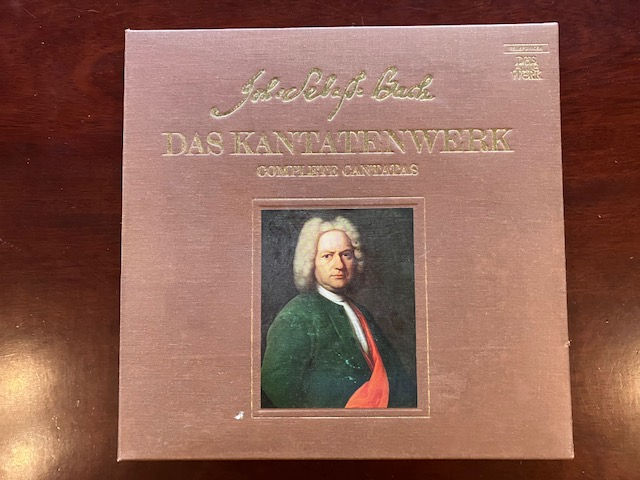
Vienna Boys’ Choir (Wiener Sängerknaben) and Concentus Musicus Wien, under the overall direction—and continuo cello performance—of Nikolaus Harnoncourt. Bach’s cantatas possess a unique quality: they invariably soothe the soul, leaving one with the desire to listen endlessly. I also listened to Cantatas Nos. 30 and 147 performed by the Munich Bach Orchestra and Choir (Münchener Bach-Orchester) under Karl Richter; with their exquisite harmonies and seamless blend of orchestral timbres, these performances can be described in a single word: magnificent.
Organ Works:


I listened to the Toccata and Fugue in D Minor (BWV 565)—among other pieces—on a record titled Orgelmusik in Ottobeuren. I acquired this record in the 1970s, during the time I was working in Germany, during a visit to the abbey in Ottobeuren (see photo above)—a small village located 100 kilometers southeast of Munich—which I frequented often.
Brandenburg Concertos Nos. 1–6: Works from Bach’s Köthen

period. Characterized by a style akin to the concerto grosso, these are truly original concertos within the Baroque repertoire—masterpieces that are both accessible and delightful to hear. I have listened to recordings by I Musici (1965) and the New Philharmonia Orchestra, as well as a
video performance by Collegium 1704 under Václav Luks. Both interpretations are excellent; the I Musici recording offers a familiar sense of stability that is deeply comforting, while the Collegium 1704 performance—filmed in the Hall of Mirrors at Köthen Castle—is a magnificent rendition brimming with the authentic atmosphere of Bach’s own era.
Violin Concerto No. 1 (BWV 1041), No. 2 (BWV 1042), and the Concerto for Two Violins (BWV 1043):

These three pieces rank
among my most cherished classical works. In 1963, having been selected by my employer as the company’s first
overseas trainee, I spent three months at the Goethe-Institut in Rothenburg ob der Tauber (West Germany), living entirely apart from other Japanese people. During that time, a friend—knowing my love for music—sent me a vinyl record featuring these works. Performed by the father-and-son duo Igor and David Oistrakh, the recording showcases a violin tone that resonates deeply with German sensibilities—a sound I have returned to dozens upon dozens of times.
Collection of Organ Miniatures (7-Disc Set):

Performed by the virtuoso Helmut Walcha (on harpsichord). I listened to all seven discs, though to be honest, it felt like “too
much.” The famous Toccata and Fugue in D Minor, BWV
565, however, is a masterpiece I frequently enjoy on its own. Since Bach was involved with organ performance throughout his life, the liner notes explain that this collection allows listeners to appreciate the distinct timbres of organs from various regions—including Southern Italy, the Netherlands, and France.
Goldberg Variations, BWV 988:

Composed to help ease the insomnia of Count Hermann Graf von Keyserlingk, the patron served by Bach’s student, Goldberg. Glenn Gould’s 1981 performance—by an artist
who devoted his life to the Goldberg Variations—radiates a profound brilliance; he employs every expressive capability of the piano, from pedaling to dynamic and tempo nuance, to bring this work vividly to life.
The Well-Tempered Clavier (48 Pieces): Just as Hans von Bülow famously likened Beethoven’s piano sonatas to the New Testament and this work to the Old Testament, this collection of preludes and fugues—composed in every major and minor key—was inspired by a new harpsichord Bach acquired during his Köthen years. The 24 pairs of preludes and fugues are arranged in ascending chromatic order, beginning with C major. Their inexhaustible depth and profundity make the Old Testament analogy truly fitting.
Mass in B Minor, BWV 232: Although the complete work is said to have been finished in 1749, it represents a monumental masterpiece from Bach’s late period—one that, in reality, took over twenty years to complete, incorporating material composed much earlier. Under Gustav Leonhardt’s direction, the music flows with a supple, unbroken grace; every part—including the instrumental lines—retains its vitality, giving the sense that each voice sings from the depths of the soul. I have listened to several performances: two recorded at St. Thomas Church—(1) conducted by Herbert Blomstedt with the Leipzig Gewandhaus Orchestra (2017), and (2) conducted by Masaaki Suzuki with the Bach Collegium Japan—as well as (3) conducted by Nikolaus Harnoncourt with Concentus Musicus Wien at NHK Hall. While all are magnificent, the performance by Blomstedt and the Gewandhaus Orchestra (1)—from the color palette of the choir’s robes to the musical execution—stands out as a superb interpretation befitting Bach’s spiritual home, one that invites repeated listening.

Sonatas and Partitas for Solo Violin: Midori Goto’s 2016 recording, captured in the Hall of Mirrors at Köthen Castle, offers a magnificent realization of the complete six-work cycle. It is a recording of exceptional caliber—both a masterpiece composition and a masterful performance—that moves the listener deeply.


Comments