.png)
12/12/2025 Thoughts on musicians and their works: "Beethoven"

Chapter 17, Ludwig van Beethoven
(1770~1827, died at 56)
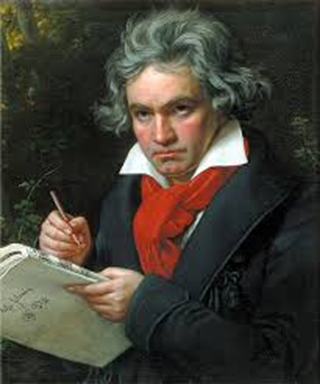
Beethoven's grandfather, a renowned bass singer from what is now Belgium, moved to Bonn and rose from singer to conductor at the Elector of Cologne’s court chapel. His father, also a court singer, subjected him to rigorous piano training from an early age, hoping to shape him into a great musician. At 16, he visited Vienna and met Mozart. During his subsequent years in Bonn, he was favored by the Breuning family and became an auditor at the University of Bonn. Influenced by the spirit of the French Revolution, he is said to have longed for freedom. At 20, he traveled to Vienna to visit Haydn, whom he had met in England, and never returned to Bonn.
His early style (1782–1803) was distinctive yet retained a strong Classical influence. His middle period (1803–1815) marked a major shift, incorporating bold techniques and passionate, powerful expression—laying the groundwork for Romantic music. This era coincided with Napoleon’s conquest of Europe, the collapse of the feudal order symbolized by the dissolution of the Holy Roman Empire, and the rise of liberalism. His later years (1815–1827) aligned with Napoleon’s decline and the reactionary regime in Vienna, during which his style reached a musical apex, characterized by introspection and a yearning for deeper human ideals.
Around age 28 (1799), Beethoven fell in love with two women—Giulietta Guicciardi and Therese Malfatti. He became engaged to Therese, but the engagement was eventually broken off, and he remained single for the rest of his life. His hearing loss worsened around this time, and at 31 (1802), he wrote the so-called “Heiligenstadt Testament,” a will addressed to his two brothers and a woman (Therese). Despite suffering from an incurable ear disease, he continued to compose with remarkable determination, entering a second creative period that produced masterpieces such as the Violin Sonata “Kreutzer” (1803) and Symphony No. 3 “Eroica” (1804), culminating in his greatest work, the Ninth Symphony “Choral” (1824).
Below are brief impressions of Beethoven’s music from performances I recently watched:
🎻 Romances: I listened to Nos. 1 and 2 performed by Heifetz. The beautiful melody of No. 2, which I’ve heard since childhood, struck a deep chord.
🎹 Piano Sonatas: I listened to Nos. 15 “Pastoral,” 17 “Tempest,” 21 “Waldstein,” 28, and 29 “Hammerklavier” performed by Pollini. No. 15’s classical, pastoral charm, No. 21’s lyrical beauty, and No. 29’s grand scale and virtuosity stood out. I also listened to Nos. 8 “Pathétique,” 14 “Moonlight,” and 23 “Appassionata” performed by Wilhelm Backhaus—masterful interpretations I’d love to revisit. Other sonatas included Nos. 1, 3, 6, 9, 12 “Funeral March,” 16, 18, 24, 26 “Farewell,” and 30–32, many heard in multiple performances. While all subtitled pieces are memorable, I find Nos. 30–32—often hailed as late masterpieces—less immediately enjoyable. Perhaps they resonate more when one is searching for life’s deeper meaning.
🎼 Piano Concertos: Nos. 4 and 5 “Emperor,” recorded by Barenboim (piano) with the New Philharmonia Orchestra conducted by Otto Klemperer, and performances by Christian Zimmermann and L. Bernstein with the Vienna Philharmonic, are magnificent works I return to often.

🎻 Piano Trio: I listened to No. 7 “Archduke” performed by three different trios.
🎻 Violin Sonatas: I heard Nos. 5 “Spring” and 9 “Kreutzer” performed by Zuckermann & Barenboim and Oistrach & Oborin. Despite record scratches and diminished sound quality due to the Great Hanshin Earthquake, they remain undeniable masterpieces.
🎻 Cello Sonatas: I listened to Nos. 1–5 performed by Rostropovich (cello) and Richter (piano). All are exceptional, with No. 3 generally regarded as the finest.

🎶 Triple Concerto for Piano, Violin, and Cello: I listened to performances by Oistrakh, Rostropovich, Richter, and the Berlin Philharmonic conducted by Karajan, as well as by Zukerman, Forsyth, Bronfman, Mutter, Yo-Yo Ma, and Barenboim. Though grander than a symphony, the weight of such virtuosity makes it feel less like everyday listening.
🎻 String Quartets: I listened to Nos. 1, 2, 7, 9 “Razumovsky,” 11, 13, and 16. I found No. 2 more accessible than No. 1, especially in the Budapest String Quartet’s performance.

🎼 Symphonies: I listened to all nine, with standout performances including:
Symphony No. 3 "Eroica": F. Wengler conducting the Vienna Philharmonic, K. Mäkela conducting the Concertgebouw Orchestra
Symphony No. 4: C. Kleiber conducting the Concertgebouw Orchestra
Symphony No. 5 "Fate": D. Barenboim conducting the Berlin Philharmonic, H. Karajan conducting the Berlin Philharmonic Orchestra
Symphony No. 6 "Pastoral": F. Wengler conducting the Vienna Philharmonic, S. Rattle conducting the Berlin Philharmonic, K. Mäkela conducting the Concertgebouw Orchestra, H. Karajan conducting the Berlin Philharmonic Orchestra
Symphony No. 7: C. Kleiber conducting the Concertgebouw Orchestra, H. Karajan conducting the Berlin Philharmonic Orchestra
Symphony No. 8: H. Karajan conducting the Berlin Philharmonic Orchestra
Symphony No. 9 "Choral": H. Karajan conducting the Berlin Philharmonic, L. Bernstein conducting the Vienna Philharmonic Orchestra.
I also listened to older recordings of No. 5 by Artur Nikisch and No. 7 by Knapperbusch. While some connoisseurs favor older recordings for their historical value, I rarely consider them definitive. A masterpiece, to me, is shaped by performance technique, venue atmosphere, and recording quality.
🎶 Missa Solemnis (Solemn Mass): Beethoven’s passion is palpable, and the work has a universal resonance beyond church music. The New Philharmonia Orchestra under Otto Klemperer delivers a grand, authoritative performance. Fabio Luisi’s rendition with the Dresden State Opera Orchestra at the Frauenkirche captures the original venue’s atmosphere beautifully.
🎭 Opera “Fidelio”: I saw four productions—La Scala, Salzburg Festival Theater, Theater an der Wien, and the Royal Opera House. The Royal Opera House’s staging and costumes made it the most comfortable and enjoyable experience.
For reference, the following table lists the works of the composers I listened to again when recording my impressions this time.


Comments